

WORLDSCALE
The New Worldwide Tanker Nominal Freight Scale, or ‘Worldscale’ for short, is a freight rate schedule that is used to calculate freight for the carriage of oil in bulk.This freight rate schedule is issued jointly by the Worldscale associations of London and New York, and was first introduced in January 1989. The schedule is a printed book and is issued every year on the of January.
The present schedule lists freight rates and distances for over 60,000 round trip voyages from the first load port to the discharge port and back to the first load port. Ports are listed in alphabetical order.
The basic rate given in the schedule is called the flat rate or the Worldscale 100 rate. This rate is in United States dollars per ton of cargo loaded, and is for a standard vessel. Some of the features of these rates are as below (as extracted from Worldscale 1997):
- Rates are based on a standard vessel that has a total carrying capacity of 75,000 tons, hired at a rate of USD 12000/- per day. The vessel is assumed to steam at 14.5 knots and consumes about 55 tons of bunkers per day at this speed. Bunker consumption per day for each port involved in the voyage is 5 tons per day. Bunker costs are based on the average bunker price of fuel oil (380 cst1) of the previous Worldscale year (meaning that for rates published in 1997, the fuel oil price is for 1996).
- The rates also take into account canal transits if any, and port costs for the said voyage.
- The rates are based on a laytime of 72 hrs for loading and discharging (reversible laytime, see 4.10.4).
- Rates can be revised during the year if there are significant changes to port charges. This is done by way of circulars that the association sends out when required.
- For ports not listed, a direct quote can be obtained from the association.
- Market levels are expressed as a percentage of the nominal freight rates for a standard vessel; thus WS100 would mean the rate issued by the association for a voyage from a load port to a discharge port and back to the load port as from the schedule. WS175 will be 175% of the rate lifted from the schedule.
- For some ports and for canal transits there are differentials that increase or decrease schedule rates. These differentials are fixed or variable and are therefore called fixed and variable rate differentials, as applicable. A fixed differential is a fixed amount that is added to the freight as calculated for a round trip voyage and does not vary with the WS rate, while a variable differential varies with the WS rate (i.e. the differential is higher in good market conditions (WS rate greater than 100) and lower in a bad tanker freight market (WS rate lower than 100)).
Using the Worldscale – to Find the Flat RateThe Worldscale lists world ports in alphabetical order in bold with WS100 freight rates and distances for voyages to other world ports, as shown below.
For example to find the WS100 rate from Bombay (the discharge port) to another port (say Aden), look at the page in the schedule with Bombay in bold and in capitals and then extract the rate and distance from the schedule for the round trip voyage to Aden.
E.g. the rate from Bombay to Aden as extracted from the Worldscale schedule of 1997 is USD 4.22 per metric tonne, while the round trip distance is 3314 nautical miles (see figure below).
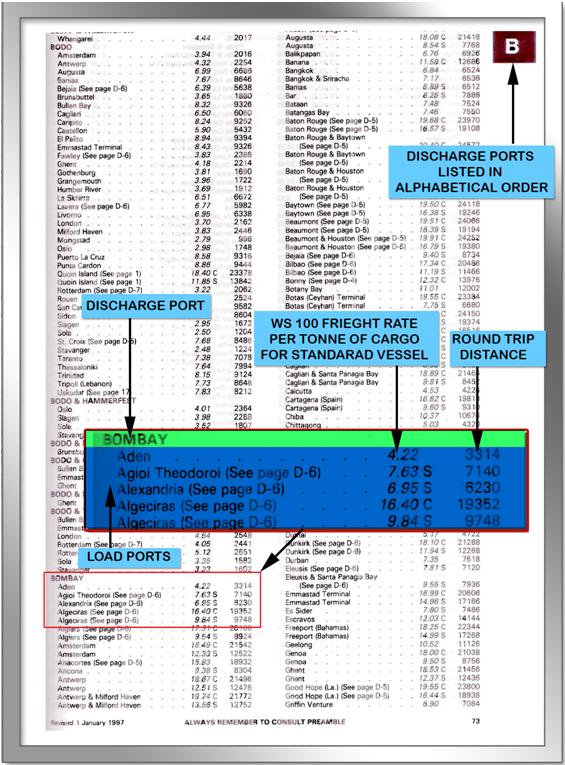
Using the ‘Worldscale’It is important to note that certain ports have more than one rate that can be lifted from the schedule. This is because the round trip voyage may have more than one route. An example in this regard would be voyages that could be routed either through the Suez Canal and around the Cape of Good Hope or through the Panama Canal and around Cape Horn.
Use of the world Scale
Brokers can easily analyse the market by checking Worldscale rates for the tanker type that is to be fixed; a rising WS index indicates a rising market while a falling index indicates lower freight prospects.
As all Worldscale calculations are based on a standard vessel, the returns for your vessel type will not necessarily be the same as that for the Worldscale vessel. This is because your vessel may be of a different size, might have a different speed, and may not have the same bunker consumption.
When using Worldscale one must compare fixtures for similar ship types. This would mean that you cannot compare a fixture rate for a VLCC with a Suezmax fixture.
One of the advantages in using Worldscale rate in a range of discharge ports, is that the owner knows that his freight returns will be the same to all ports within the discharge range. However large differences in port costs can affect vessel earnings when freight rates are either very high or very low.