

System of Bill of Lading
The system of the bill of lading in relation to the delivery of goods is as below:B/Ls can be made deliverable to:
- A named person, a name left blank or a bearer bill.
- In the first two cases the bill may or may not be made deliverable by the words ‘order or assigns’.
- Bills of lading making goods deliverable to ‘order’ or to ‘order or assigns’ are, by mercantile custom, negotiable instruments. In this regard a negotiable instrument is an instrument that can transfer the goods to another person.
- Transfer of title to goods is effected by ‘endorsement’ i.e. where the shipper or consignee signs his name on the back of the bill of lading. This is if the words ‘order or assigns’ are written after the named person in a named bill of lading.
The bill of lading is a document of title; an explanation of how ownership of goods can be transferred during transit is explained below, with an example:
In this example, Shipper ‘C Low’ has received a bill of lading for 100 tonnes of chopsticks from the carrier after placing the chopsticks on board the said carrier. The named consignee in the B/L is R Tata.R Jain is a third party.The possible ways for the bill of lading to be laid out and the goods transferred are:
- The bill of lading has only R Tata written in the consignee space. The goods can only be collected by R Tata when he produces the B/L. This is an example of a named bill of lading (or a closed B/L).
- The bill of lading has R Tata or ‘order’ or R Tata or ‘order or assigns’ typed in the consignee space. The goods can be transferred to R Jain if R Tata writes R Jain’s name on the B/L and signs. This is called an endorsement in full. R Jain could transfer the goods by endorsement if the words ‘order or assigns’ are written after his name when endorsed by R Tata.
- The bill of lading has R Tata or ‘order’ or R Tata or ‘order or assigns’ typed in the consignee space. R Tata signs the B/L with no named recipient. This called ‘an endorsement in blank’. The goods can be transferred from hand to hand by mere transfer of the B/L document.
- The bill of lading has ‘bearer’ or ‘order’ in the consignee space; this is a bearer bill of lading. Goods can be transferred on transfer of the bill of lading by hand. There will be no record of transfer.
- The consignee space is left blank. This is an open bill of lading. Goods can be transferred on transfer of the bill of lading by hand. There will be no record of transfer.
- An open or a bearer bill could be made non-transferable by an endorsement to a named person.
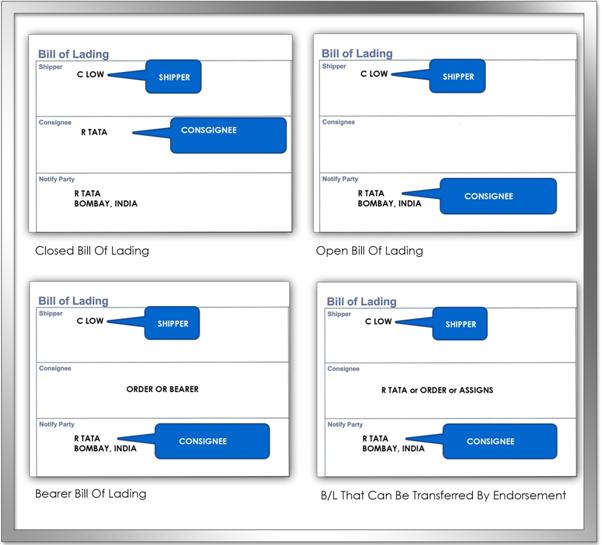
The bill of Lading System
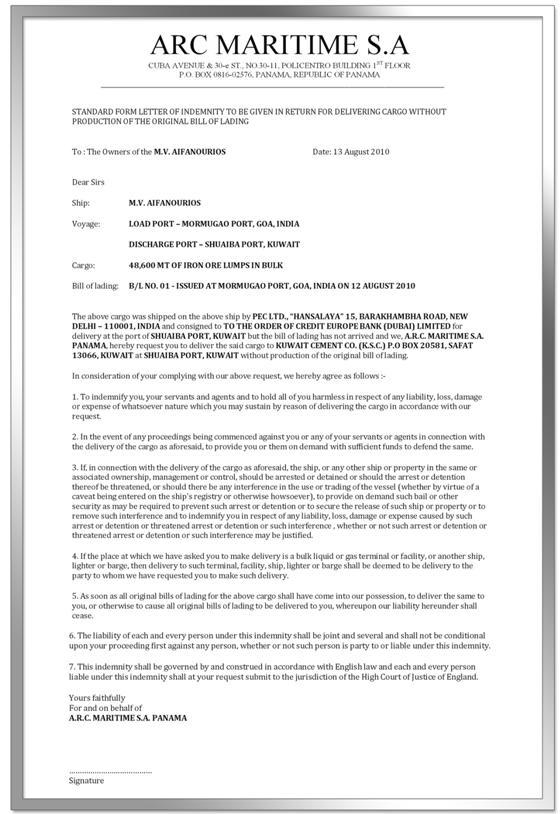
A Letter of Indemnity for the delivery of cargo without a B/L