

Pirate Attack

Piracy and armed attacks continue to occur on an increasingly frequent basis at sea. Armed robbery occurs mostly in port areas, while piracy occurs at sea. Piracy occurs outside the jurisdiction of the state. In this form of terrorism well armed pirates attack, then board a ship and then hold the officers and crew on board for ransom money. This type of attack is common in Somalia.
Terrorism usually involves violence, or the threat of violence, by extremist groups seeking to gain political objectives by malicious means. They do this by using various types of bombs, bomb threats or hijacking a ship. Increasingly, they are acting with extremist religious sects that promote suicidal behaviour.
Incident Statistics
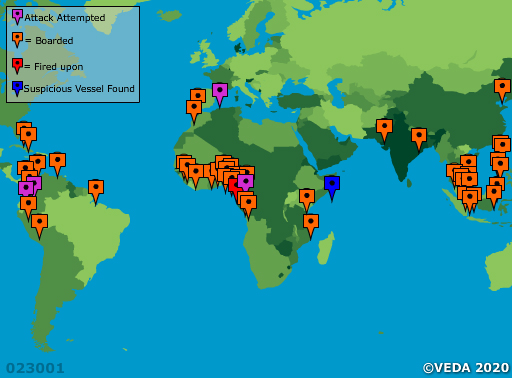
IMB Piracy & Armed Robbery Map 2019
The map above shows all piracy and armed robbery incidents reported to IMB Piracy Reporting Centre during 2019.
There were 239 global security incidents at sea in the first half of 2017, as shown in the figure below:
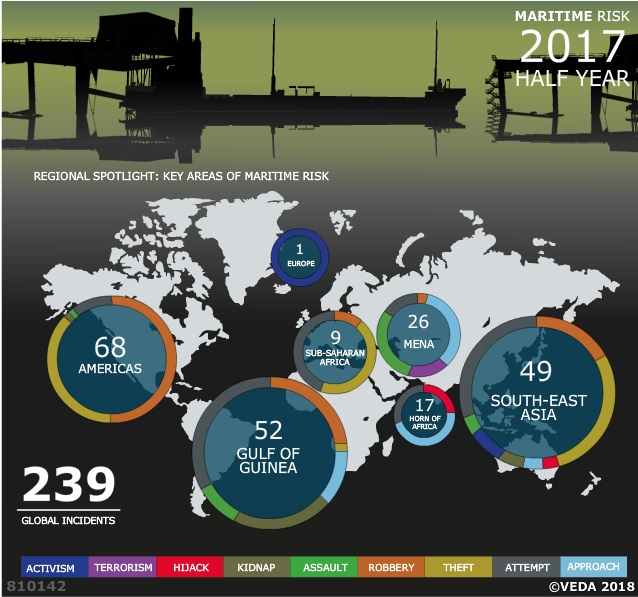
Security incidents 2017
However as the figure below illustrates there was a decrease in security related incidents at sea in 2017 compared to 2016.Also shown are Top locations for port and anchorage crime in 2017.
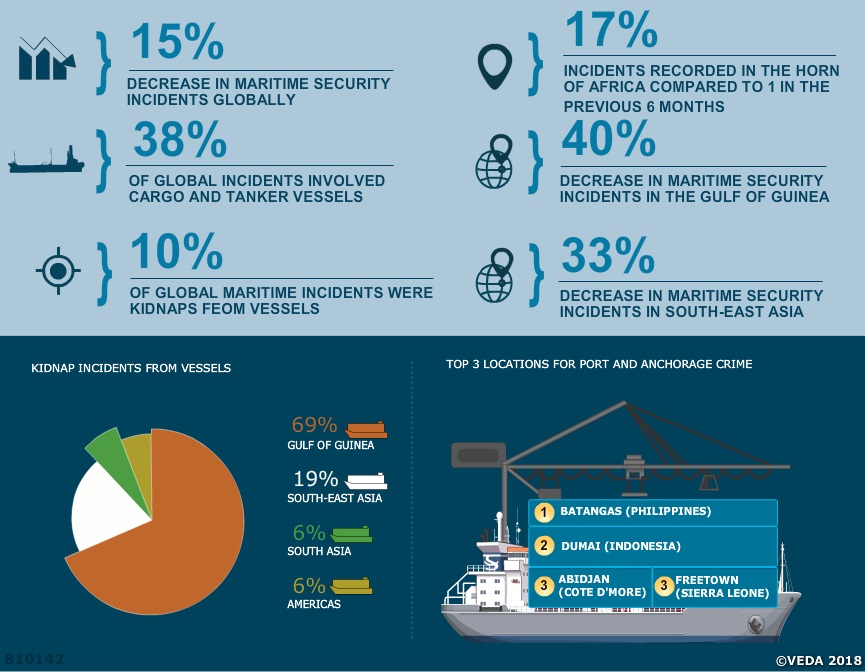
Decrease in Security related incidents in 2017
The vessel types targeted are as below:
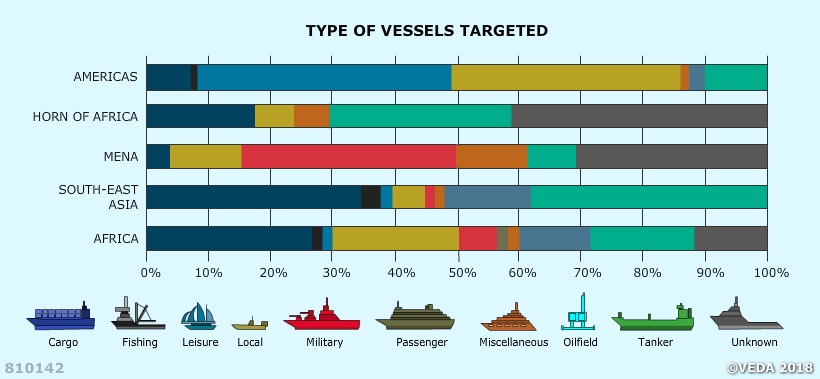
Vessel types targeted
The motivation of piratesA study on Piracy off the Horn of Africa reveals, while the profitability of piracy appears to be the primary motivating factor for most pirates, other observers argue that since conditions in Somalia make survival difficult for many and prosperity elusive for most, the relative risk of engagement in piracy seems diminished.
According to the final report of the experts group convened in 2008 by the U.N. Special Representative to Somalia, “poverty, lack of employment, environmental hardship, pitifully low incomes, reduction of pastoralist and maritime resources due to drought and illegal fishing and a volatile security and political situation all contribute to the rise and continuance of piracy in Somalia.”
Pirate activity and ransom revenues have increased significantly in the past years, and many now assert that Somalia’s economy and its population are increasingly dependent on piracy. The average ransom paid in 2010 has been estimated at over $5.4 million—with more than 50 reported hijackings per year, this places the pirates’ 2010 ransom revenues at over $250 million. U.N. officials argue that the insecurity caused by piracy deprives northern Somalia, which has not been as affected by the armed conflict in central and southern Somalia, of a variety of job-creating investments, from port operations to commercial fishing. Somali pirates interviewed by the international media frequently link their pirate activities to trends such as illegal fishing and dumping in Somali waters that have emerged as the country has lost its ability to patrol its waters over time.
While these explanations may mask the opportunistic piracy of some, reports suggest that illegal fishing and dumping have disrupted Somalia’s coastal economy. Recent estimates by the United Nations suggest that Somalia may lose $95 million annually to illegal fishing.
The international Contact Group on Piracy off the Coast of Somalia stated at its inaugural meeting that “piracy is symptomatic of the overall situation in Somalia including the prevalence of illegal fishing and toxic waste dumping off the coast of Somalia, which adversely affects the Somali economy and marine environment.”
The CGPCS also reaffirmed “its respect for Somalia’s sovereignty, territorial integrity, and sovereign rights over natural resources” and underscored that the group’s participants “ensure that their flagged vessels respect these rights.” Paradoxically, the regional fishing industry reportedly has been damaged significantly by the threat of piracy. According to some reports, tuna catches in the Indian Ocean fell 30% in 2008, in part because of fishing vessels’ fears of piracy. This has had a major impact on countries like the Seychelles, which rely on the fishing industry for up to 40% of their revenues, and on Yemen, which reported an estimated $150 million in lost fishing sector revenues in 2009.
So, Piracy is mainly driven by a series of ‘push’ factors, which are:
- Sheer poverty;
- A lack of opportunity on-shore
- Lack of faith in Government and Security Forces to support one’s livelihood e.g., via the ‘fishing’ industry
‘Pull’ factors that can drive piracy away are:
- Unparalleled economic possibilities,
- Active role in fighting against Illegal, Unreported and Unregulated (IUU) fishing
- Active role in defending territorial waters (e.g. Somalia)