
Other Trading Certificates
Panama Canal Tonnage Certificate
Panama Canal tolls are charged by the Panama Canal Authority and are based on the ship’s “Panama Canal/Universal Measurement System” (PC/UMS) net tonnage which is an adaptation of the measurement system used under the International Convention on Tonnage Measurement (1969), modified for Panama Canal purposes by applying a mathematical formula to her total volume measured for the International Tonnage Certificate.-
A certificate entitled PC/UMS Documentation of Total Volume:
- Must be obtained by the owner of a ship which will (at some time) transit the Panama Canal for the first time.
- A ship will usually carry the document from the time of building, even though she may not transit the canal for some time thereafter.
- Is issued by the ship’s classification society (Flag State in case of an unclassed ship) following measurement under the Panama Canal Authority’s Rules for
- Measurement of Vessels for the Panama Canal.
- Shows that the vessel has been measured and assigned the total volume in cubic metres as shown.
- Shows the ship’s main particulars – length, breadth, depth, gross tonnage and net tonnage as stated on the International Tonnage Certificate (1969), number of passengers, number of containers above deck, total volume in cubic metres based on rules for measurement for the Panama Canal , PC/UMS Net Tonnage, quantity of bunker fuel for Ballast Rate, place and date of issue. On reverse: details of elements of total volume; details of excluded spaces.
- Will be retained by the Panama Canal Authority following the first transit, after which a permanent certificate PC/UMS Net Tonnage Certificate will be delivered to the vessel on the next subsequent transit The plans will be returned to the vessel via its agent after the Panama Canal net tonnage is verified by the PCA.
Panama Canal Maiden Visit
A vessel on its maiden transit of the Panama Canal must, on arrival at the canal entrance, have its total volume verified by the Panama Canal Admeasurer under the rules of the Panama Canal Authority. The PC/UMS Documentation of Total Volume and/or a copy of the International Tonnage Certificate (1969) must be presented to the Boarding Official of the Canal Authority. The Authority will then verify the tonnage data on the Documentation of Total Volume and, if satisfactory, will deliver to the ship a PC/UMS Net Tonnage Certificate for future transits
A vessel arriving at the canal for the first time should have ready a StandardDocumentation Folder containing:
- General ship information;
- Copy of the International Tonnage Certificate (1969)
- Copy of ITC 69 tonnage computation.
- General Arrangement plan including profile
- Number of years of service as Chief Engineer
- Capacity Plan with deadweight scale
- Midship Section Plan
- Lines Plan
- International Load Line Certificate (1966)
- Suez Canal Special Tonnage Certificate (if available).
- A copy of the “Admeasurement Data Sheet Form” (duly completed and sent by shipowner to the Panama Canal Admeasurement Division prior to the scheduled arrival at the Canal).
Suez Canal Tonnage Certificate
Suez Canal tolls are charged by the Suez Canal Authority and are based on the ship’s Suez net tonnage, as measured under the Suez Canal Authority’s Rules (which are called “the Rules adopted by the International Tonnage Commission at Constantinople”) and shown on a Suez Canal Special Tonnage Certificate.:-
Suez Canal Special Tonnage Certificate:
- Is issued by the ship’s classification society (Flag State in case of an unclassed ship) following a measurement survey conducted in accordance with the Canal Authority’s rules at the time of shipbuilding.
- It is to be produced for inspection by the Canal Authority on every arrival at a Suez Canal entrance.
- It certifies that the ship has been re-measured, and that the tonnage ascertained (as shown) is in accordance with the Rules adopted by the International Tonnage Commission.
- It shows the ship’s main particulars;
- Details of tonnage when passing through the Suez Canal (GT and NT by actual measurement);
- NT by Danube Rule;
- Place and date of issue.
- On reverse:
- Deductions from Gross Tonnage;
- Full dimensions and tonnage of exempted and open spaces;
- Detailed measurements of machinery spaces;
- Notes referring to particulars of deducted spaces.
- It is valid until any change in dimensions used in the tonnage measurements.
Deratting Certificate
The International Health Regulations require that every ship must be either permanently kept in such a condition that it is free of rodents and the plague vector or be periodically deratted. A ship must have a valid Deratting / Deratting Exemption Certificate. The vast majority of ships normally carry a Deratting Exemption Certificate.
- Deratting is the process of getting rid of rodents from a ship and hence a Deratting Certificate will be issued when deratting has been completed to the satisfaction of the authorized health authority for a port.
- It will be replaced by a Deratting Exemption Certificate if after the ship’s inspection the authorized health authority is satisfied that the ship is free from rodents and the plague vector.
- Is valid for a maximum of 6 months, extendable by one month where the ship is proceeding immediately to an approved port or designated approved port
Deratting Exemption Certificate
- It is issued if after the ship’s inspection the authorized health authority is satisfied that the ship is free from rodents and the plague vector.
- Will be replaced by a Deratting Certificate following any deratting completed to the satisfaction of the authorized health authority.
- Is valid for a maximum of 6 months, extendable by one month where the ship is proceeding immediately to an approved port or designated approved port.
- Will be issued only if the inspection was done with the holds empty or containing only ballast or material that is unattractive to rodents and of such a nature or so disposed as to allow a thorough inspection.
- May be issued to an oil tanker with full tanks.
If a valid certificate is not produced when demanded, the health authority for a port may proceed tom get the ship deratted under its direction and control deciding the technique to be employed to secure the extermination of rodents on the ship. Deratting shall be done to avoid as far as possible damage to the ship and to any cargo and shall not take longer than is absolutely necessary.
Contents of Deratting / Deratting Exemption Certificate
Front Page: Certificate name (both names are printed; the inapplicable name is deleted by the issuing officer; port, date, statement as follows:
“This Certificate records the inspection and deratting / exemption at this port and on the above date of (ship’s name)…of…(net tonnage)… At the time of the inspection/deratting the holds were laden with……..tons of ………………cargo. “Recommendations made (in the case of exemption): (here are stated the measures taken for maintaining the ship in such a condition that it is free of rodents and the plague vector, e.g. “vessel maintained in a clean and rodent free condition throughout”.
| Compartments Rat | Rat indications | Rat Harbours discovered | Rat harbour s treated | Space (cubic feet) | Quanti-ty used | Rats found dead | Traps set or poisons put out | Rats caug-ht or killed |
| 1 | ||||||||
| 2 | ||||||||
| 3 | ||||||||
| 4 |
The Certificate bears the seal, name, qualification and signature of the Inspector. r. (“Rat indications” in column 2 include old or recent evidence of excreta, runs or gnawing. “Quantity used” in column 6 refers to the weight of sulphur / cyanide salts / quantity of HCN acid used)
Ship Sanitation and Hygiene Certificate
This certificate may be issued to a ship by a port health authority to record an inspection of the ship in accordance with International Health Regulations. The record of inspection covers:-
- Potable water
- Waste disposal
- Accommodation
- Swimming pools
- Food sanitation.
Details of unsatisfactory conditions or practices to be remedied are listed.
| Ref. No | Location | Defect | Action required |
| 1 | |||
| 2 | |||
| 3 | |||
| 4 |
The certificate is usually signed and issued by an Environmental Health Officer of the issuing health authority.
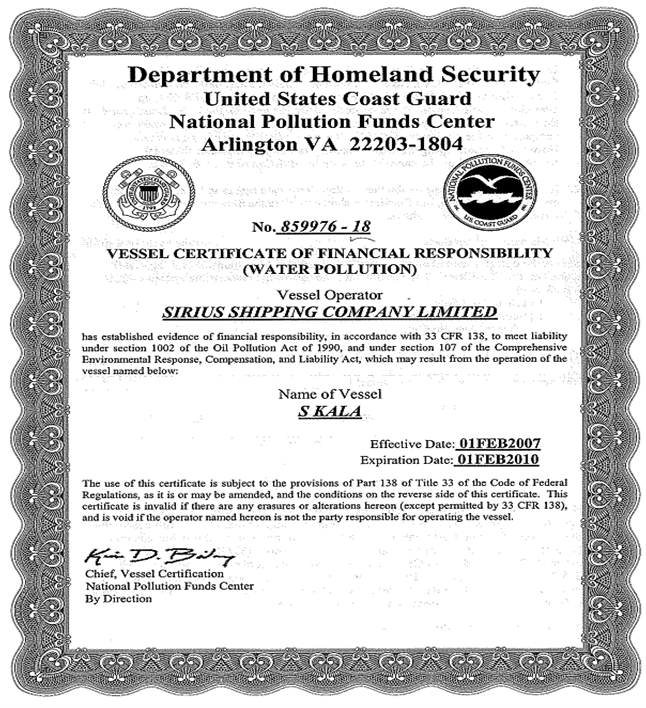
CERTIFICATE OF FINANCIAL RESPONSIBILITY
COFR is a vessel Certificate of Financial Responsibility (Water Pollution) issued by the National Pollution Fund Centre (NPFC) of the United States Coast Guard to a vessel applicant providing evidence of financial responsibility, in accordance with the Oil Pollution Act of 1990 (OPA 90) and CERCLA. The Coast Guard have transitioned to a paperless COFR, which is an electronic record accessible on their website when the COFR is issued. Operators will no longer be required to carry a paper COFR aboard the vessel. COFR validity will be verified electronically.
Vessel operators must have a COFR for vessels over 300 gross tons using the navigable waters of the United States. In addition, any vessel, REGARDLESS OF TONNAGE, that is LIGHTERING or TRANSSHIPPING oil in the Exclusive Economic Zone (EEZ) of the United States, must have a COFR. The only exceptions to this rule are public vessels and non-self propelled barges that do not carry oil as fuel or cargo, and do not carry hazardous substances as cargo. These two types of vessels do not require a COFR.
CERTIFICATE OF FINANCIAL RESPONSIBILITY