
Measures to prevent the spread of disease by shipping
Shipboard Measures to Address Risks Associated with COVID-19
Under the ISM Code, ship operators are required to assess all identified risks to their ships and personnel and establish appropriate safeguards. As a result, shipping companies should develop plans and procedures to address the risks associated with the COVID-19 pandemic to the health of seafarers and the safety of their ship operations.
Whilst maritime occupational safety and health measures on board ships, including various plans and procedures, may already be set out in their safety management system (SMS), ship operators may identify a need to amend or revise certain measures in light of the COVID-19 pandemic. Shipboard measures to respond to the risks associated with COVID-19 may cover the following:Information about the coronavirus (COVID-19)
- Symptoms and incubation period
- Transmission
- Personal protection
- Infection prevention
- Testing and treatment
- Awareness and training
Shipboard measures to address risks associated with COVID-19
- Measures to protect health and prevent infection
- Monitoring and screening
- Personal protective equipment (PPE)
- Testing and assessment
- Shipboard self-distancing (SSD)
- Cleaning and disinfection
- Measures to manage risks during embarkation
- Measures to manage risks during disembarkation
- Measures to manage risks associated with the ship/shore interface
Managing an outbreak of COVID-19 on board ship
- Actions required if any person on board displays symptoms of COVID-19
- Definition of a suspected case of COVID-19
- Identification of close contacts and contact tracing
- Measures to limit exposure to other persons on board ship
- Isolation of suspected cases of COVID-19
- Caring for suspected cases of COVID-19
- Disembarkation of suspected cases of COVID-19
- Cleaning and disinfection of the ship
Ships should receive information and instructions about the measures introduced by the company to address the risks associated with COVID-19. Ship operators should ensure that seafarers are familiarized with their ship’s plans and procedures related to health protection during the COVID-19 pandemic, in particular those related to actions to take if any persons on board display symptoms of COVID-19 infection in order to initiate management of the potential outbreak.
Protective and Hygiene Measures
Ship operators should provide seafarers (and passengers where applicable) with general information on COVID-19 and applicable standard health protection measures and precautions.
The person(s) responsible for medical care on board ships should be informed and updated about the outbreak of COVID-19 and any new evidence and guidance available. It is recommended that they regularly review the WHO website for COVID-19 advice and guidance.
Human-to-human transmission of COVID-19 is understood to occur primarily through droplet spread. A person with COVID-19 coughs or sneezes, spreading droplets into the air and onto objects and surfaces in close proximity. Other people breathe in the droplets or touch the objects or surfaces and then touch their eyes, nose or mouth.
Seafarers (on board ship or on leave) should inform their healthcare providers if they have visited an area with community spread of COVID-19 in the past 14 days, or have been in close contact with someone with respiratory symptoms who has been to an area with community spread of COVID-19.
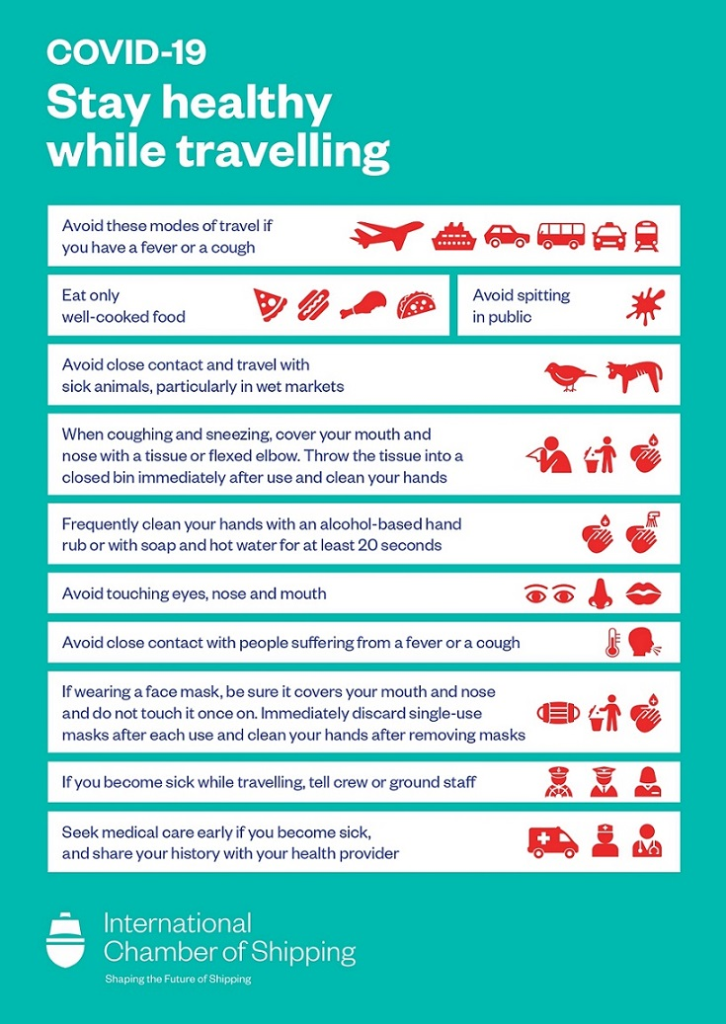
Seafarers with fever, cough or difficulty breathing must seek medical attention promptly.
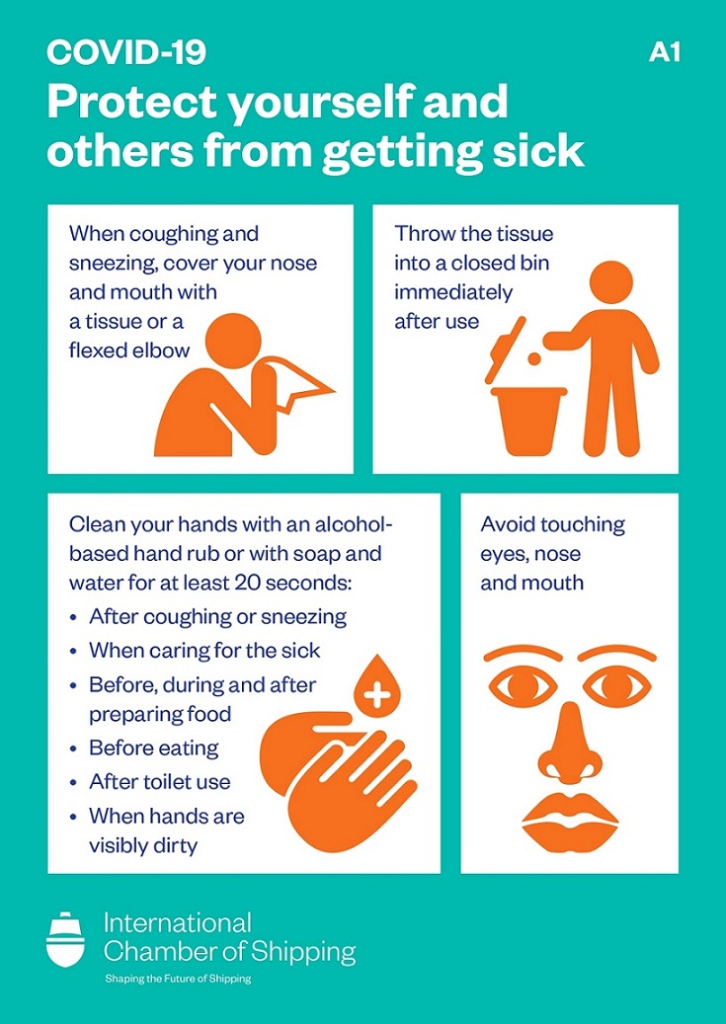
Standard Infection Protection and Control (IPC) precautions emphasise the vital importance of hand and respiratory hygiene. Shipping companies should provide specific guidance and training for seafarers regarding:
- Frequent hand washing using soap and water or alcohol-based (at least 65–70%) hand rub for 20 seconds;
- When hand washing is essential (e.g. after assisting an ill seafarer or after contact with surfaces they may have contaminated, etc.);
- When to hand rub with an antiseptic instead of hand washing, and how to do this;
- Avoidance of touching the face including mouth, nose and eyes with unwashed hands (in case hands have touched surfaces contaminated with the virus);
- Covering the nose and mouth with a disposable tissue when sneezing, coughing, wiping and blowing the nose and disposal of the used tissue immediately into a waste bin;
- If a tissue is not available, covering the nose and mouth and coughing or sneezing into a flexed elbow;
- Aiming to keep at least one metre (three feet) distance from other people, particularly those that cough or sneeze or may have a fever;
- Placing the toilet lid down before flushing; and
- Handling meat, milk or animal products with care, to avoid cross-contamination with uncooked foods, consistent with good food safety practices.
It is important that seafarers should be given the time and opportunity to clean their hands after coughing, sneezing, using tissues, or after possible contact with respiratory secretions or objects or surfaces that might be contaminated.
Managing Cases of COVID-19 On Board Ship When at Sea
Despite the development and implementation of measures to mitigate the risk of COVID-19 infection on board ships, there is a risk that shipboard personnel or passengers may become infected and begin to display symptoms of COVID-19.
Suspected Cases of Infection
COVID-19 affects different people in different ways. According to WHO the following symptoms may be experienced:
| Common symptoms | Less common symptoms |
| fever | aches and pains |
| dry cough | nasal congestion |
| tiredness | headache |
| conjunctivitis | |
| sore throat | |
| diarrhea | |
| loss or change in taste/smell | |
| rash on skin | |
| discoloration of fingers and toes |
Anyone displaying the above symptoms should report immediately to the person responsible for medical care on board, the outbreak management plan should be activated, the person should be considered as a suspected case of COVID-19, and should be isolated in their own cabin or ship’s medical facility to await further assessment. This assessment should ascertain whether there is another likely cause, e.g. allergy, tonsillitis, etc.
The assessment as to whether a seafarer is likely to have COVID-19 rather than another respiratory infection must be based on factors including:
- Symptoms reported and findings on examination by the person responsible for medical care on board;
- Recent (last 14 days) travel history;
- Recent shore leave;
- Recent contact with visitors to the ship; and
- Recent contact with people with symptoms suggestive of COVID-19.
If COVID-19 cannot be satisfactorily excluded the seafarer must be treated as a positive case until further assessment shoreside or until the symptoms have completely disappeared and a period of isolation has been completed. The WHO currently recommends isolation for ten days from the onset of symptoms, plus at least three additional days without symptoms.
The following are risk factors for severe disease:
- Over 60 years old;
- Underlying noncommunicable diseases (e.g. diabetes, hypertension, cardiac disease, cerebrovascular disease, chronic kidney disease, immunosuppression or cancer); and
- Smoking.
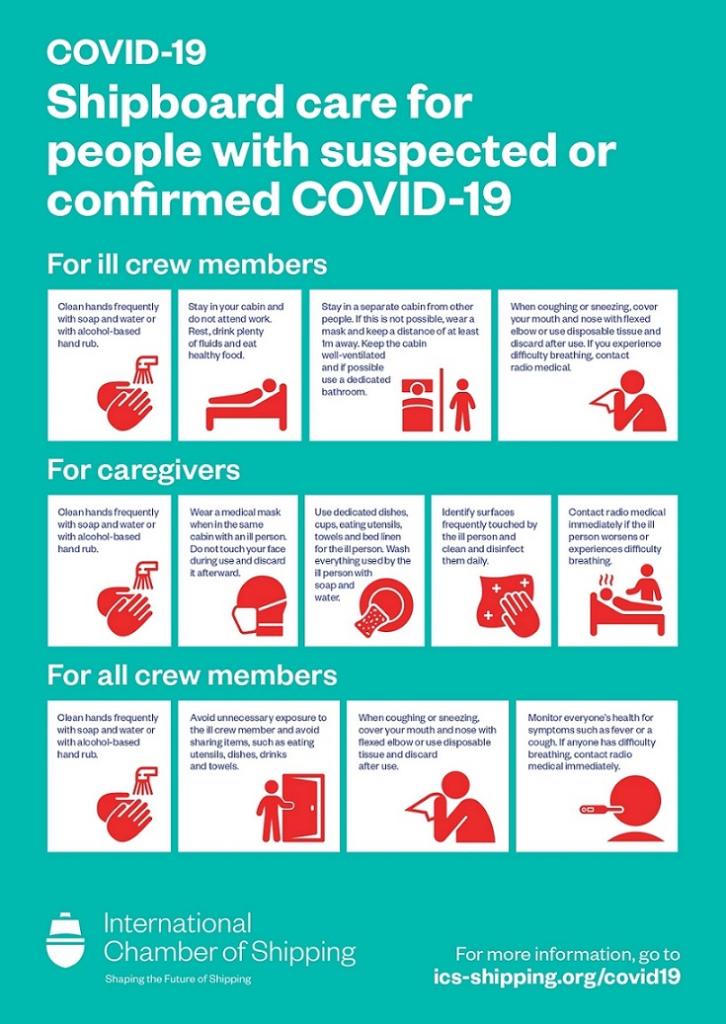
Isolate the patient in the sickbay, or in their own cabin, and make sure they wear a medical mask when in contact with other people. The patient should have access to a bathroom not used by others.
Anyone entering the same room as a suspect case should wear PPE, which should include a medical mask, apron or impermeable gown (if available), gloves, and goggles or a visor. Contact with the suspect case should be limited to a maximum of two other seafarers. Thoroughly wash hands immediately before and after leaving the patient’s cabin.
Supportive treatment may include the relief of pain and fever, ensuring enough fluid is taken, and oxygen and other treatments if necessary.
Paracetamol should be given for the relief of pain and fever. Advice regarding the use of Ibuprofen is conflicting, therefore it should only be used after consultation with a doctor. Any additional medication should also be discussed with a doctor ashore before being prescribed on board.
The patient’s condition should be assessed regularly – two or three times per day. The patient must also have an easy and reliable way to contact others in case of concern.
The port health authority in the next scheduled port should be informed of the suspected COVID-19 case on board as soon as possible. They should then assist in the management of the case once the ship arrives into port and coordinate testing of the patient and others on board in line with local policy.
Assistance for all Seafarers to Access Medical Care in Ports
Under the ILO MLC 2006, port States must ensure that any seafarers on board ships in their territory who need immediate medical care are given access to medical facilities on shore. However, medical assistance to seafarers in ports is now limited and, before sending a seafarer ashore for medical care, the person(s) responsible for on board medical care should be in direct contact with the receiving medical service.
Further medical care can be arranged through the ship’s agent or other port intermediaries. This is necessary as hospitals and clinics may not be allowed, or may not want, to receive patients that are at risk of infection, or potentially a risk of causing infection or considered not urgent.
If a seafarer cannot be brought ashore for medical care, the person(s) responsible for on board medical care must seek advice from a medical advice service with experience in handling medical issues and to identify possible contacts on land, if this has not already been done.
If a seafarer has not had contact with anyone for 14 days with COVID-19 and is not showing any symptoms of COVID-19, they are unlikely to pose a risk and port authorities should use discretion and identify suitable aid and assistance.
Ship visitors and other intermediaries in ports should be made aware of the seafarer’s situation and try to mediate where possible.
Some seafarers in critical need of medical attention have been prevented from disembarking for urgent treatment. There have also been occasions when it has proved difficult to properly manage removal of seafarers who have died on board.
National and local restrictions are impacting seafarers who require urgent medical care, both for COVID-19 and non-COVID-19 cases. The ILO, IMO and WHO have reminded all member States that seafarers are key workers and entitled to medical care and assistance under the IHR, SOLAS, MLC and STCW. Shipping companies experiencing such issues should contact their flag State and telemedical services for urgent assistance.
Port Entry Restrictions
According to the IHR (and other international regulations), States Parties shall not refuse to grant ‘free pratique’ (permission to enter a port, embark or disembark, or discharge or load cargo or stores) for public health reasons. States Parties may subject the granting of free pratique to inspection, and, if a source of infection or contamination is found on board, conduct necessary disinfection, decontamination, disinfection or deratting, or other measures necessary to prevent the spread of the infection or contamination. Nevertheless, many governments have introduced national and local restrictions, including:
- Delayed port clearance;
- Prevention of crew (or passengers where applicable) from embarking or disembarking (preventing shore leave and crew changes);
- Prevention of discharging or loading of cargo or stores, or taking on fuel, water, food and supplies; and
- Imposition of quarantine or refusal of port entry to ships (in extreme cases).
While such measures can severely disrupt maritime traffic – and may well be in breach of the IHR, the IMO Convention on Facilitation of International Maritime Traffic (FAL Convention), and other maritime principles regarding the rights and treatment of seafarers (and passengers where applicable) – the reality is that shipping companies may have little choice but to adhere to these national and local restrictions due to the serious concern about COVID-19 and the potential risk to public health.
However, it is critical that port States accept all types of ship for docking and to disembark suspect cases, as it is difficult to test, isolate and treat suspect cases on board and could endanger others.
ILO and IMO have advised that during the ongoing COVID-19 outbreak, effective protection of the health and safety of seafarers must remain a priority.
Under the ILO Maritime Labour Convention (MLC):
- Flag States must ensure all seafarers on ships flying their flag are covered by adequate measures to protect their health and that they have access to prompt and adequate medical care while working on board; and
- Port States must ensure that any seafarers on board ships in their territory who need immediate medical care are given access to medical facilities on shore.
Together with flag States, companies and Masters should co-operate with port State health authorities to ensure that public health measures are completed satisfactorily.