
Chartering
Shipping plays a vital role in international trade. Huge volumes of cargo or goods are transported by water. Chartering is about arranging this transportation of cargo by sea. A charterer employs a broker to find a shipowner from whom he can hire a ship for a voyage or for a period, to carry cargo for a certain freight rate. Ships engaged in carriage of goods may not be directly operated by shipowners. Instead, they maybe chartered / leased from shipowners by shipping companies/operators for a specified period, as per the governing contract.
This course will give you an understanding of negotiating a contract and the performance of a charter. You will also get an insight of the various issues involved in chartering and the precautions that need to be taken for a successful charter.
A Charter Negotiation
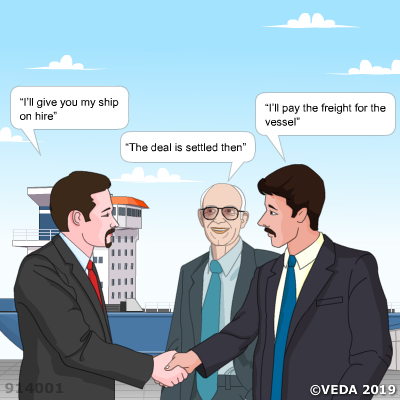
Ships are fixed on charters arranged between the ship owner and charterer by the “shipbrokers”, acting as negotiators for, the “ship owner” and the “charterer”. Shipbrokers may comprise of:-
- The ship owners’ brokers, who arrange employment for their principals’ ships;
- The charterers’ brokers, who find ships to carry out their principals’ requirements;
- The tanker brokers, who arrange for oil-cargo fixtures in the specialist tanker market;
- The liner brokers who find cargo for liner owners and operators;
- The coasting brokers who work in the short-sea market and often combine the functions of owners’ and charterers’ brokers;
- The ship’s agents, who are employed by ship owners and charterers to service their vessels’ needs in ports; and,
- Sale and purchase brokers, who buy and sell ships and can, if necessary, arrange new-building contracts for their principals.
The basic stages of the “cargo fixing process” are as follows:-
- Charterers’ broker to circulate the “cargo orders”, broadly indicating the charterer’s forthcoming cargo transportation needs;
- Owners’ broker to circulate the “position lists” or “tonnage lists”, indicating the “open” dates and positions of the ships which are available;
- Feedback on the “market reports” by the brokers is taken.
- For arriving at a decision or even otherwise, exchange of “terms and conditions”, between brokers, on behalf of their respective principals, trading offers by both sides. In case, the main terms and conditions can not be resolved, the discussions on further details are no longer continued.
- Further discussions are held on various “secondary conditions”, provided the main terms and conditions have been agreed upon.
- Fixture, i.e. the full and final agreement of the “cargo fixing”.
Shipbrokers are remunerated by the payment of a “commission”, also known as “brokerage”, which is payable by the ship owner to each broker, who is involved in arranging a contract.
For voyage and time charters, the brokerage payable is specified in a particular clause in the agreement, which is normally 1.25 % of the ship owner’s gross receipts, from hire, freight, dead freight (the amount a shipper needs to pay, when the shipper does not utilize the space he has reserved on a ship) and demurrage, as payable to each broker who is involved.
The global “professional body of shipbrokers” is the London-based “Institute of Chartered Shipbrokers” (website: www.ics.org.uk), whose motto is, “Our Word, our Bond”. The said institute sets professional standards for shipbrokers, through annual examinations.