

Some important Clauses in Chartering
BOTH TO BLAME COLLISION CLAUSE:-
An example:
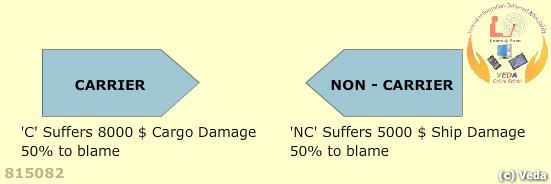
Under the Negligent clause the carrier has no liability for loss or damage arising from errors or faults in the navigation or management of the ship as per the terms of bills of lading. However in American law the cargo interests are entitled to recover 100% of damages from the non-carrying ships even if each ship is partly to blame. The owners of the non-carrying ship are entitled to recover from the carrying ship, the proportion of the amount that they have been called upon to pay. Thus in this example cargo owners can claim their full 800$ loss from the non-carrier. In turn the owners of the Non-carrier will include in their claim against the owners of the carrier 50% of that amount i.e. 4000$. Over and above this they will also claim 2500$ as 50% of damage to their own ship. So the Non-carrier total claims against the carrier will be 6500$.
The object of the Both to blame collision clause is to enable the owners of the carrying ship to recover the amount of damage indirectly paid by them to the cargo owners.
However American law do not recognize the negligent clause and they have also not ratified the 1910 collision convention. But they have ratified the HAGUE AND HAGUE-VISBY RULE which contain an exemption under maritime perils. Collision is considered to be a maritime peril. Therefore the cargo owner can technically only, claim from the non-carrying ship as above.
The US supreme court declared the Both to blame collision clause invalid. But as collision liability was also being decided and in other countries even if the US had held it invalid to avoid legal difficulties American bills of lading added a new Both to blame collision clause. This clause comes into effect if the liability for any collision in which the vessel is involved while performing this bill of lading fails to be determined in accordance with US laws.
NEW BOTH TO BLAME COLLISION CLAUSE If the ship comes into collision with another ship as a result of the negligence of the other ship and any act, neglect or default of the master, mariner, pilot or the servants of the carrier in the navigation or in the management of the ship, the owners of the goods carried hereunder will indemnify the carrier against all loss or liability to the other or non-carrying ship her owners in so far as such loss or liability represents loss of or damage to or any claim what so ever of the owner of the said goods, paid or payable by the other or non-carrying ship or her owners to the owners of the said goods and set off, recouped or recovered by the other or non-carrying ship or her owners as part of their claim against the carrying ship or carrier.
Hence in the above example the cargo owner has no recourse except to recover all his losses for cargo damage from the non-carrying ship in case of collision. The non-carrying ship thereafter sues the carrying ship and claims the proportion of losses as determined by the degree of blame attached to the carrying ship.
Thereafter if “both to blame collision clause” or New BTBCC is upheld by the court then the cargo owner indemnifies the carrier to the loss damage paid by the carrier to the non-carrier for cargo damage claims.
Therefore in effect the non-carrying ship will get only 2500$ as 50% of their claim for ship damage and the cargo owner will have to bear his loss through his underwriters.
NEW JASON CLAUSE
- American law disallows the cargo owner to give contribution in general average caused by the negligence of the ship owners.
- The ship owner then seeks to excuse himself from liability for losses from these causes by inserting a clause in the bill of lading / C/P forcing the cargo Owner to contribute his proportion in general average.
- However under an act of U.S. law it is illegal (Harter act 1893) to insert any such claim in the bill of lading excusing the ship from liability for loss caused through negligence, improper stowage etc.
- In spite of this a clause was put regularly in all bills of lading giving the owners to claim general average contributions from cargo owners.
- On a ship called S.S. JASON in 1904 such a claim arose in US waters and the US courts upheld this clause in 1911. Since then it has been called the JASON CLAUSE and later on it was extended to include salvage and it is now called the new or amended JASON CLAUSE which is commonly found in all C/P and B/L.
CESSER & LIEN CLAUSE
- In case the charterers are only agents or brokers for loading the cargo which belonging to a third party, they would not like their liability to extend once the cargo is loaded.
- This is expressed in a Cesser clause which states that the charterers liability will cease on shipment of cargo and payment of freight, deadfreight and demurrage i.e. expenses incurred at the loading port.
But the shipowner on the other hand would try to protect themselves in case there is a breach of contract or damage done to their vessel after charterers liability have ceased and will want to take legal action against someone else, usually the receiver. Therefore if there is a Cesser clause, a lien clause is also included in the charter party which gives right to the owners to retain goods in their possession until outstanding debts are paid at the discharge port. Both clauses are therefore combines. The shipowner first sues the receivers but the charterers will still be liable for expenses which are not recoverable from the consignees.