

Cargo Calculations
In the voyage estimation process, cargo calculations help one determine revenue that a vessel can earn for a voyage.
To determine the amount of cargo that a vessel can carry, one must know the following:
- The deadweight of the vessel (Deadweight All Told, DWAT) and Deadweight Cargo Capacity, DWCC)
- The load line zone that she will be operating in
- The stowage factor of the cargo
- The amount of bunkers and fresh water required for the voyage
The deadweight of the vessel is the carrying capacity of a vessel, DWAT is the total carrying capacity of the vessel by weight, while DWCC is the earning capacity of the vessel or the cargo carrying capacity of the vessel by weight.
The amount of cargo that the vessel can carry could be based on weight for cargoes that have a small stowage factor (space occupied by one tonne of cargo in cubic meters), or by volume for cargoes that have a large stowage factors.
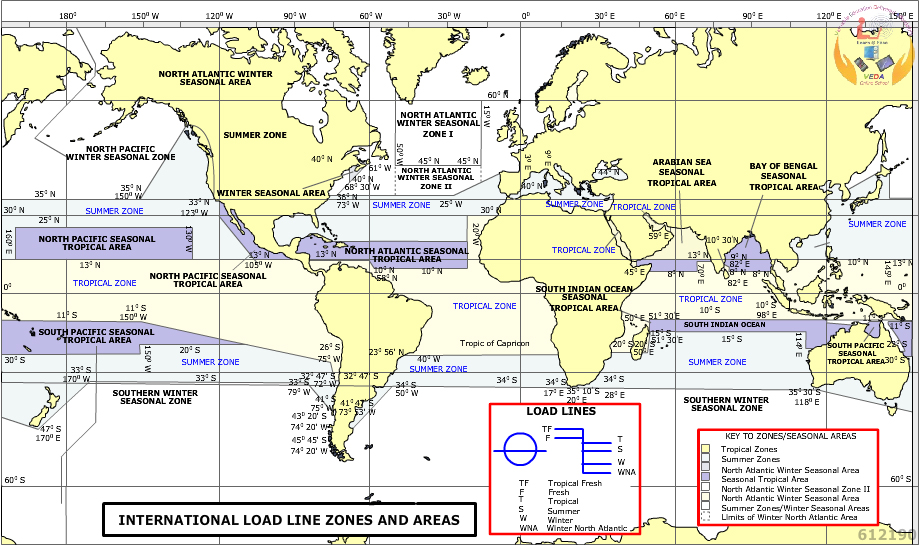
For freight calculations by weight, one must know the loadline zone the vessel will be trading in as the trading zone determines the amount of cargo that she can load. There are 3 main loadline zones in the world, as follows:
- The Tropical zone (where the vessel can load a maximum amount of cargo by weight).
- The Summer zone.
- The Winter zone (where the vessel loads the least amount of cargo by weight). There is also a Winter North Atlantic zone, but this is only applicable to vessels less than 100 meters in length, plying in areas north of the arctic circle (66oN).
A good estimator will maximize the amount of cargo a vessel can load, by taking the following factors into account:
- The fuel consumption during the voyage for freight calculations by weight (this helps one estimate how much fuel the vessel is required to have on board, with the required safety margin)
- If the vessel is to go, for e.g., from the summer zone to the winter zone, then how much extra cargo can be taken to submerge her winter marks so that when the vessel arrives in the winter zone, her winter loadline is not submerged? (One must note that the vessel will lighten by the amount of fuel consumed for a passage from the departure summer zone port to arrival at the summer/winter zone boundary)
- If cheaper fuel is available en-route, a good estimator will allow for the vessel to sail with just enough fuel with a margin of safety to arrive at the bunkering port (place where the vessel loads fuel) to stem bunkers as required
- For cargoes with high stowage factors the estimator must estimate the maximum amount of cargo that the vessel can carry by volume, as with these cargoes the vessel’s cubic capacity will be fully taken up without her being loaded down to her loadline mark, i.e. she is full in relation to space available for the carriage of cargo, but not in relation to her DWCC
- The estimator must accurately estimate the amount of fresh water, fuel, provisions and other weights on board that must be subtracted from DWAT to obtain DWCC
From revenue earned by way of freight for cargo carried, one must deduct the Expenses of the vessel to determine the vessel’s net income for the voyage
.
1. A bulk Carrier (Summer DWT 88,500, Winter DWT 87,750, Tropical DWT 89,250) daily consumption F.O. 45t and FW 14t. She is chartered for voyage from Odessa to Sakal taking fuel oil and FW at Aden (minimum quantity) and at Singapore (FW required quantity and maximum fuel oil possible). She is also rquired to load 9 containers at Singapore, each weighing 28 tons for Hong Kong.
| Odessa to Port Said | 4 days |
| Suez to Aden | 6 days |
| Aden to Marmugoa | 5 days |
| Marmugoa to Singapore | 9 days – 3 days in Summer adn the rest Tropical |
| Singpore to Hong Kong | 8 days – 1 days in Tropical 2 days in Seasonal Tropical in winter months and the rest in summer zone. |
| Hong Kong to Sakai | 3 days – 1 day in Summer and rest Winter. |
ROB at Odessa FO 848t FW 293 t and stores 180 t. Estimated consumption for Suez Canal Transit FO 50 t and FW 40 t. Ignore all port consumptions. Allow 2 days fuel and FW reserves at all times at sea. Find the amount of cargo to load at Marmugoa and FO FW to be taken on board at Aden and Singapore.
Ans. Cargo 87,334 Tons Aden 372/111 Singapore 495/154
ODESSA TO SAKAI
DAILY CONSUMPTION HO-45.0 FW 14.0
TWO DAYS RESERVE HO-90.0 FW 28.0
| F.O. | F.W. | CONST. | CARGO | ||
| Odessa | Dep | 848 | 293 | 180 | |
| Con | 180 | 56 | |||
| Port Said | Arr | 668 | 237 | ||
| Con | 50 | 40 | For transit | ||
| Dep | 618 | 197 | |||
| Con | 270 | 84 | |||
| Aden | Arr | 348 | 113 | ||
| Rod | 372 | 111 | |||
| Dep | 720 | 224 | |||
| Con | 225 | 70 | |||
| Marmugoa | Arr | 495 | 154 | 180 | 87, 334 |
| Dep | 495 | 154 | |||
| Con | 405 | 126 | |||
| Singapore | Arr | 90 | 28 | ||
| Rod | 495 | 154 | 252 | ||
| Dep | 585 | 182 | 180 | ||
| Con | 360 | 112 | |||
| Hong Kong | Arr | 225 | 70 | -252 | |
| Dep | 225 | 70 | |||
| Con | 135 | 42 | |||
| Sakal | Arr | 90 | 28 | 180 | |
| Dep. Hong Kong | 225 | 70 | 180 | ||
| Ond day consumption | 45 | 14 | |||
| Arr. Winter Zone | 180 | 56 | 180 | 87,334 | |
| Cargo Loadable 87,334 | |||||
2. A vessel has summer deadweight of 24,562 MT (Summer Draft 10,56 M TPC 25 MT) Her daily consumption of fuel oil is 25 MT and fresh water 11 MT. She is loading at Campana Bay, Chile for Le Havre, France. As per the company’s instructions, the vessel is to maintain 2 days of reserve of fuel oil and 4 days of reserve of fresh water at all times at sea. Prior departure Campana Bay, the vessel haad fuel oil 415 MT and fresh water 190 MT. The vessel will bunker enroute at Panama.
Calculate the maximum amount of cargo to load at Campana Bay and the fuel oil, fresh water to be taken at Panama to complete the voyage if,
a) Campana Bay to Panama – Tropical Zone – 9 days
b) Panama to Seasonal Tropical Area – Tropical – 3 days
c) Seasonal Tropical Area to Seasonal Winter Zone – Summer – 8 days
d) Seasonal Winter Zone to Le Havre – Winter – 9 days.
Ans. 23,594 tons. Panama 360/173
CAMPANA BAY TO LE HAVRE
DAILY CONSUMPTION F.O. 25.0 FW 11.0
| SUMMER | 24,562 T | |||
| WINTER | 24,012 T | |||
| TROPICAL | 25,112 T | |||
| F.O | F.W | |||
| CAMPANA | DEP. | 415 | 190 | |
| 9 DAYS | CON. | 225 | 99 | |
| PANAMA | ARR. | 190 | 91 | |
| RCD. | 360 | 173 | ||
| 20 DAYS | DEP. | 550 | 264 | |
| CON. | 500 | 220 | ||
| LE HAVRE | ARR. | 50 | 44 | |
| HO | FW | |||
| DEP. PANAMA | ROB | 550 | 264 | |
| CONSUMPTION 11 DAYS | 275 | 121 | ||
| ROB ARRIVAL WINTER ZONE | 275 | 143 | ||
Cargo Loadable 23,594 Tons
3. A vessel Summer deadweight 15,300 t, tropical dwt. 15,800 t, winter dwt 14,800 t is to load in Yokohama for Boston, calling at Singapore, Colombo and Aden. The ship is to load 4,500 t of cargo at Singapore and 850 t of cargo at Colombo. Oil fuel initially on board at Yokohama 372 t, daily consumption 48 t. Fresh water initially on board 120 t daily consumption 18 t. There are to be 3 days reserve of oil fuel and fresh water at all times. Oil fuel and FW to be taken at Yokohama, Singapore, Colombo and Aden as required.
Yokohama to Singapore, summer zone, 10 days
Singapore to Colombo, tropical zone, 5 days
Colombo to Aden, tropical zone, 6 days.
Aden to Port Said, tropical zone, 5 days.
Port Said to Boston, first 4 days summer, than 10 days winter.
Calculate the maximum amount of cargo to load at Yokohama, and also the oil fuel and fresh water to take at the various ports.
Ans. Cargo 8,592 tons, Yokohama 252/114, Singapore 240/90, Colombo 288/108, Aden 912/342
YOKOHAMA TO BOSTON
DAILY CONSUMPTION : HO 48.0 FW 18.0
| Port | HO | FW | CARGO | |
| Yokohama | Arrival | 372 | 120 | |
| Received | 252 | 114 | * | |
| 10 days | Departure | 624 | 234 | |
| Consumpt | 480 | 180 | ||
| Singapore | Arrival | 144 | 54 | |
| Received | 240 | 90 | * 4,500 | |
| 5 days | Departure | 384 | 144 | |
| Consumpt | 240 | 90 | ||
| Colombo | Arrival | 144 | 64 | |
| Received | 288 | 108 | * 850 | |
| 6 days | Departure | 432 | 162 | |
| Consumpt | 288 | 108 | ||
| Aden | Arrival | 144 | 54 | |
| Received | 912 | 342 | * | |
| 19 days | Departure | 1,056 | 396 | |
| Consumpt | 912 | 342 | ||
| Boston | Arrival | 144 | 54 | |
ROB @ Winter ZONE 9 days after departure ADE
Consumption HO 432 FW 162
ROB HO 624 FW 234 Cargo 5,
CARGO LOADABLE 8,592 TONS
4. A ship, summer DWT 92546 t on 13,44 m draft adn TPC 46 is loading at Dalian (China) for Europort, bunkering at Singapore and Capetown, ROBs at DAlian FO/620 t (daily consumption 42 t at sea), FW/210 t (daily consumption 12 t) & stores 82 t. constant 524 Five days reserve of fuel and fresh water are to be maintained at all times at sea. (Ignore port consumption).
1500 t of cargo is to be loaded at Colombo.
Passages/Zones are estimated to be:
Dalian to Singapore (8 days) : Summer 3 days, rest in Tropical.
Singapore to Colombo (6 days) : Tropical
Colombo to Capetown (17 days) : 3 days Tropical, than 10 days in Seasonal
Tropical area – Summer & the rest in Seasonal
Tropical area – Tropical.
Capetwon to Europort (16 days) : 2.5 days Tropical, then 3 days Summer, than
4.5 days in Seasonal Winter Zone in Winter & the rest in Winter Zone
Find the maximum cargo that can be loaded at Dalian, and what additional quantity of cargo, if any, can be lifted from Capetwon if just the required amount of bunkers were to be taken at Singapore and Capetwon.
Ans. Cargo 88,315 tons, Singapore 892/222, Cape Town 672/192
DALLAN TO EUROPORT
DAILY CONSUMTPION N.O. 42.0 FW. 12.0
| SUMMER | 92,646 T | ||||
| WINTER | 91,258 T | ||||
| TROPICAL | 93,834 T | ||||
| F.O | F.W | STORES | CARGO | ||
| DALLAN | DEP | 620 | 210 | 606 | |
| CON | 336 | 96 | 606 | ||
| SINGAPORE | ARR | 284 | 114 | 606 | |
| RCD | 892 | 222 | 606 | ||
| DEP | |||||
| CON | |||||
| COLOMBO | ARR | ||||
| RCD | 606 | 1500 | |||
| DEP | |||||
| CON | 966 | 276 | 606 | ||
| CAPE TOWN | ARR | 210 | 60 | 606 | |
| RCD | 672 | 192 | 606 | ||
| DEP | 882 | 262 | 606 | ||
| CON | 672 | 192 | 606 | ||
| EUROPORT | ARR | 210 | 60 | 606 | |
| CAPE TOWN | DEP | 882 | 262 | 606 | 1500 |
| 5.5 DAYS | CON | 231 | 66 | ||
| WINTER ZONE | ARR | 651 | 186 | 606 | 1500 |
CARGO LOADABLE 88315 TONS
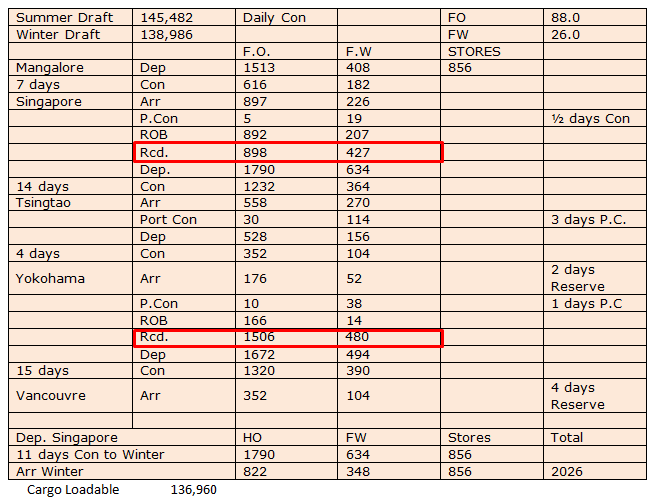
6. A large OBO of SDWT 145,482 t on a draft of 15.36 m has TPC of 203. Her daily consumption at sea is FO/88 t and FW/26 t. Port consumption is FO/10 t & FW/38 t. She is chartered to load Indian iron ore from Mangalore for Tsingtao (China) calling at Singapore (for taking the required quantity of fuel oil and fresh water) & Yokohama (for taking sufficient FO/FW to reach Vancouver).
ROBs are estimated to be FO/1513 t, FW/408 t & stores etc. /856 t on departure Mangalore.
Mangalore to Singapore (loaded): 7 days – first day in Summer, then 1 day in Seasonal Tropical zone & the remaining in Tropical.
Singapore to Tsingtao (loaded): 14 days – first 3 days in Tropical Zone then 2 days each in Seasonal Tropical (summer) and Seasonal Tropical (Winter), Thereafter 4 days in Summer zone & the rest in Winter zone.
Tsingtao to Yokohama (in ballast): 4 days – Winter first, then Summer & then the Winter zone again.
Yokohama to Vancouver (in ballast): 15 days by Great Circle track (Winter zone throughout) OR 16 days by the Rumbling rack (Summer zone throughout).
Port stays/reserves: Half a day at Singapore 3 days at Tsingtao & 1 day at Yokohama.
Charters require two days reserve of FO/FW to be maintained between Mangalore/Yokohama & four days reserves of FO/FW to be onboard from Yokohama onwards.
Calculate what Maximum Cargo you can lift from Mangalore & what Quantity of fuel oil/fresh water would you order for Singapore and/or Yokohama.
Ans. Cargo 1,36,912 tons, Singapore 908/465 Yokohama 1,584/468 R.L. G.C. 1,496/442
Mangalore to Vancouver
7. A VLCC is delivered to Charterers at Hong Kong for a single voyage with FO/1853 t & FW/254 t being ROBs. She is to load a full cargo of crude oil from Dumai (Indonesia) for discharging 120,000 t at Sydney (Australia) & the rest at Auckland (New Zealand). Singapore is the bunkering port for FO. Required quantity of FW can be picked up from any port. On completion of discharge the vessel would be delivered back to Owners with the minimum reserves of FO & FW.
Her summer DWT is 3021,258 t (TPC 206, draft 20.16 m). Daily at sea she consumes FO/82 t 7 FW/nil (self-sufficient on generated water). In port she consumes FO/7 t 7 FW/18 t everyday.
Hong Kong to Dumai : 9.5 days
Dumal to Singapore : 2.5 days – Tropical
Singapore to Sydney : 12 days – 1 day in Tropical, then 3 days in seasonal
Tropical in winter months, rest in Summer.
Sydney to Auckland : 5 days – 1 day in Summer, then 2 days in seasonal Winer in winter months, rest in Winter
Expected port stays are : 2 days in Dumai, 1 day each at Singapore & Sydney and 3 days at Auckland, Additionally she requires FO/45 t at Sydney and FO/74 t for discharge & COW at Auckland.
She must retain 850 t of ballast on board upto Singapore only, for even keel passage through Malacca Straits. 2 days FO & 200 t FW is to be maintained as reserve on board at all times at sea as well as in port.
The Charterers require you to advise them the maximum cargo tonnage that you can lift from Dumai, as well as the FO & FW requirements based on the above information.
Ans. 2,99,417, Singapore 857/18, Sydney FW/54
Hong Kong to Aukland
| Sea FO | FW | PORT FO | FW | |||
| S.DWT | 301, 258 | Daily Con | 82 | Nil | 7 | 18 |
| Winter DWT | 293,606 | 2 days Res | 164 | 200 | ||
| FO | FW | Ballast | ||||
| Hong Kong | Dep | 1853 | 254 | |||
| 9.5 days | 779 | |||||
| Dumai | Arr | 1074 | 254 | 850 | ||
| Port Stay 2 days | 14 | 36 | 850 | |||
| Dep | 1060 | 218 | 850 | |||
| 2.5 days | 205 | 850 | ||||
| Singapore | Arr | 855 | 218 | 850 | ||
| Port Stay 1 day | 7 | 18 | ||||
| Rod | 857 | Nil | ||||
| Dep | 1705 | 200 | ||||
| 12 days | 984 | |||||
| Sydney | Arr | 721 | 200 | |||
| Port Stay 1 day | 7 | 18 | ||||
| Cow | 45 | |||||
| Received | 72 | |||||
| Dep | 669 | 254 | ||||
| 5 days | 410 | |||||
| Aukland | Arr | 259 | 254 | |||
| Port Stay 3 days | 21 | 54 | ||||
| Cow | 74 | |||||
| Redelivered | 164 | 200 | ||||
| Dep Singapore | 1705 | 200 | ||||
| 1 day to Summer | 82 | |||||
| Arr. Summer | 1623 | 200 | 299,435 |
10. A tanker summer displacement 18,480 t, light displacement 6350 t, summer draft 9.60m TPC 26, FWA 18cms, loads at Baton Rouge for Boston. Distance to reach the open sea 240n.miles. River speed 12k, sea speed 14k, oil fuel consumption per day 12k 24t, at 14k 40t. Fresh water consumption whilst underway 12t per day. Pilot trimming water on board leaving Baton Rouge 85t.
The vessel loads in dock water RD 1.005 distance from Baton Rouge to Boston 2088 miles. On reaching the open sea the vessel steams for 2.5 days in summer zone before entering winter seasonal zone in winter.
Calculate the maximum amount of cargo to load assuming there is sufficient oil fuel on board to take the vessel to Boston and return to Baton Rouge with 2.5 days reserve at all times.
There is sufficient F.W. to reach Boston with 10t in reserve. Find also the draft on sailing from Baton Rough.
Ans. 11,104 Draft 9.636
| FO | FW | Ballast | Cargo | DWT | |
| Dep B/R | 580 | 86 | 85 | 11,104 | 11,855 240 miles @ 12K Consumption F24T/FW 12 |
| Con | 20 | 10 | 85 | ||
| Arr BW | 560 | 76 | 0 | 11,104 | S.DWT 12,130 |
| 2.5 | 100 | 30 | 520 | ||
| Arr. Winter | 460 | 46 | 0 | 11,104 | 11,610 Winter DWT 11610 |
| 120 | 36 | 0 | |||
| Arr. Boston | 340 | 10 | 0 | 11,104 | |
| Con | 220 | Total Sea Passage 2088-240 =1848 | |||
| Arr B/W | 120 | 1848 Miles @ 14K = 5.5 Days | |||
| 20 | WD | 9.40 | 9.6 | ||
| ROB B/R | 100 | DW All | 0.144 | ||
| 9.544 | |||||
| 0.0942 | |||||
| SAILING DRAFT | 9.6382 | @1.005 | |||
11. A vessel of Summer DWT 93542 t at summer draft of 14.40 TPC 42, stores and constant 380 t is loaded to her summer DWT at Le Have with 340 t of ballast on board and with FO 740 t and FW 350 t as ROB. She is to load 380 t of cargo from Gibralter and 780 t from Las Palmas. He route is estimated as follows:
Le Havre to Gibralter 2 days- Summer Zone
Gibralter to Casablance 0.5 days – Tropical Zone
Casablanca to Las Palmas 2 days – Tropical Zone
Las Palmas to Abidjan 1 day in Tropical then 2 days in Seasonal Tropical (S) then 5 days in Seasonal Tropical (W)
Abidjan to Cape Town 11 days – 1 day in Summer Zone, 6 days in Seasonal Tropical (W) and rest in Winter Zone
Cape Town to Durban 2 days – Winter Zone
She has to discharge 1500 t cargo at Casablance, 1000 t each at Abidjan and Cape Town, Required quantity of FO and FW is to be replanished at Las Palmas maintaining three days reserve of FO and FW at all times at sea. Daily consumption FO 341 and FW 18t.
Find how much additional cargo can she lift from Las Palmas if the ballast was pumped out at sea one day prior arrival Gibralter. (Ignore all port consumption)
Ans. FO 229 FW 163 Cargo 676
| SDWT | 93,542 | SD | 14.4 | TPC | 42 | |||
| Daily CC 3 days Res | FO | 34 102 | FW | 18 54 | ||||
| HO | FW | Ballast | Const | Cargo | Cargo | DWT | ||
| Le Havre | Dep | 740 | 350 | 340 | 380 | 91,732 | 93,542 | |
| 2 days | 68 | 36 | ||||||
| Gib. | Arr | 672 | 314 | |||||
| Rcd. | +380 | |||||||
| Dep | 672 | 314 | ||||||
| 0.5 days | Con. | 17 | 9 | |||||
| C’blanca | Arr. | 655 | 305 | |||||
| Disch | -1500 | |||||||
| Dep | ||||||||
| 2 days | Con. | 68 | 36 | |||||
| L. Palmas | Arr. | 587 | 269 | |||||
| Rcd. | 229 | 163 | +780 | |||||
| Dep | 816 | 432 | -340 | 380 | 91,392 | 93,020 | ||
| 8 days | Con. | 272 | 144 | |||||
| Abidjan | Arr. | 544 | 288 | |||||
| Disch | -1000 | |||||||
| Dep | 544 | 288 | 90,392 | |||||
| 11 days | Con. | 374 | 198 | |||||
| Cape Town | Arr | 170 | ||||||
| Disch | -1000 | |||||||
| Dep | 170 | 90 | ||||||
| 2 days | Con. | 68 | 36 | |||||
| Durban | Arr | 102 | 54 | |||||
| Dep. Las Palmas DWT 93,020 Summer DWT 93,542 Additional Cargo Loadable Las Palmas 522 Plus Tropical to Summer 3 days Con. 156 Additional Cargo Loadable Las Pal 678 | ||||||||
Last 6 days are in Winter Zone by which time vessel will be well below here Winter Marks since she is to discharge 1,000 tones at Abidjan and bunkers consumed for 15 days Las Pimas to Winter Zone.